Projects · 2011–2013
Liquid CO2 slurry for feeding low-rank coal to gasifiers
A twelve-month U.S. Department of Energy project on replacing water with liquid carbon dioxide as the carrier fluid for low-rank coal fed to gasifiers. The award was held by the Electric Power Research Institute; the Dooher Institute of Physics and Energy was one of four named team members.
The technical problem
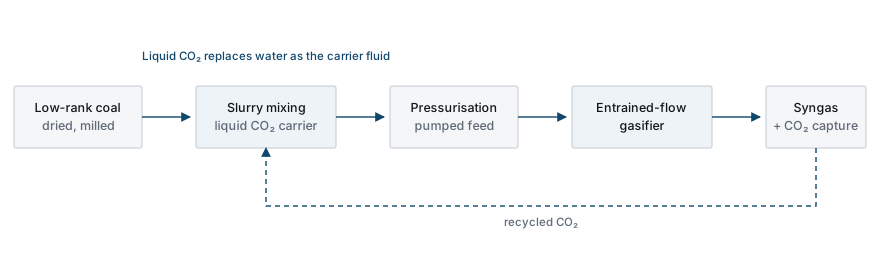
Entrained-flow gasifiers are usually fed a coal–water slurry, which is convenient to pump but costly in energy: all of the water must be vaporized inside the gasifier, and the heat of vaporization is lost to the process. Low-rank coals — lignites and subbituminous coals, which are abundant and cheap — make the penalty worse, because their high inherent moisture means that a pumpable slurry carries proportionately less coal. The result is that the fuels which are most plentiful are the ones a conventional slurry-fed gasifier handles least efficiently.
Liquid carbon dioxide is an alternative carrier. Its viscosity is lower than that of water, its heat of vaporization is far lower, and its surface tension is lower by roughly two orders of magnitude — the properties cited in the project’s DOE record. In a plant that already captures carbon dioxide, a stream of it is available on site, so the carrier can in principle be recycled rather than consumed. Whether the combination is favorable is a question about the rheology of the slurry, the energy balance of pressurizing and recycling the carbon dioxide, and the cost of the additional equipment — which is what the project set out to examine.
Objectives and scope
The National Energy Technology Laboratory’s Gasification Systems Overview of 12 July 2012 lists the project under low-rank coal research and describes its scope as:
- conducting plant-wide technical and economic simulations;
- developing a preliminary design and cost estimate of a slurry preparation and mixing system;
- performing laboratory tests of the rheological properties of liquid CO2 / low-rank-coal slurry.
The Department of Energy’s announcement summarizes the rationale: “Slurries of liquid carbon dioxide (CO2) and low-rank coal can potentially lower the cost and increase the efficiency of IGCC power plants with carbon capture.”
Participating organizations
The Department of Energy’s announcement of 9 September 2011 states: “EPRI will team with Dooher Institute of Physics and Energy (Garden City, N.Y.), Worley Parsons Group, Inc. (Houston, Texas), Columbia University (New York, N.Y), and ATS Rheosystems/REOLOGICA (Bordentown, N.J.).”
| Organization | Location as published | Position |
|---|---|---|
| Electric Power Research Institute, Inc. | Palo Alto, California | Award recipient |
| Dooher Institute of Physics and Energy | Garden City, New York | Named team member |
| Worley Parsons Group, Inc. | Houston, Texas | Named team member |
| Columbia University | New York, New York | Named team member |
| ATS Rheosystems / REOLOGICA | Bordentown, New Jersey | Named team member in the DOE announcement; not listed in the NETL overview of July 2012 |
Funding, stated precisely
The announcement covered six projects supported with up to $14 million in total. For this project it gives two figures:
| Item | Amount |
|---|---|
| DOE share | $817,316 |
| Recipient share (Electric Power Research Institute) | $204,329 |
| Project duration | 12 months |
What these figures do and do not mean
The DOE share was awarded to the Electric Power Research Institute as the recipient. The recipient share is EPRI’s cost contribution. No public record discloses any amount received by the Dooher Institute of Physics and Energy, and the Institute does not claim to have received the DOE share or any stated portion of it. The announcement states no total project value, and none is asserted here.
The Institute’s role
The Department of Energy and NETL both name the Institute as a team member. Neither document assigns specific tasks to individual team members. The Adelphi University faculty record for John P. Dooher describes his contribution as “rheology testing and technical input in the recent million dollar DOE/EPRI project on feeding low rank coal to gasifiers with liquid carbon dioxide”. That description comes from the university record rather than from a DOE document, and is reproduced here on that basis.
Timeline
- 9 September 2011
The Department of Energy announces six IGCC projects, naming the EPRI project team including the Dooher Institute of Physics and Energy. Stated duration: 12 months.
- 12 July 2012
NETL’s Gasification Systems Overview v3.0 lists the project under “CO2 Slurry Feed” with the title Liquid CO2 Slurry for Feeding Low Rank Coal (LRC) Gasifiers and sets out the three-part scope.
- 2013
The final technical report, Liquid CO2/Coal Slurry for Feeding Low Rank Coal to Gasifiers, is deposited with the DOE Office of Scientific and Technical Information under contract FE0007977, OSTI record 1122274, with the Electric Power Research Institute as corporate author.
- 2019
Related peer-reviewed work on carbon dioxide for viscosity reduction and solid-fuel dispersion in IGCC plants is published in Fuel, with John Dooher as a co-author. doi:10.1016/j.fuel.2019.115848
Reports and related publications
- Liquid CO2/Coal Slurry for Feeding Low Rank Coal to Gasifiers — final technical report, DOE contract FE0007977, OSTI record 1122274. The OSTI record lists only the Electric Power Research Institute as corporate author; individual authors are not shown in it, so this site does not state who is named on the report.
- The Adelphi University faculty record cites the final report as “DOE-EPRI-007977, 12/23/2013”. That report number and date appear on no DOE or OSTI page located in this survey, although the number is consistent with the OSTI contract number FE0007977. They are recorded here as reported by the university record and not independently confirmed.
- Related conference presentations in 2011 and 2012 are listed on the publications index in the section for items without a located publisher record.
- Tupsakhare, S., Dooher, J., Modroukas, D. & Castaldi, M. (2019), Fuel 256, 115848 — peer-reviewed work on the same underlying idea.