Research · Research group
Energy physics & advanced energy systems
Research directed by John P. Dooher on the gasification of coal and biomass, the preparation and feeding of slurry fuels, carbon-dioxide-based carrier fluids, and the modeling of energy-conversion systems.
Scope
This is the Institute’s principal research area and the one in which the Institute itself has been a named participant in externally funded work. The program is concerned with how solid fuels of low quality — low-rank coals, biomass, and mixtures of the two — can be converted efficiently to synthesis gas, hydrogen and power, and specifically with the physics of getting such fuels into a high-pressure gasifier at all.
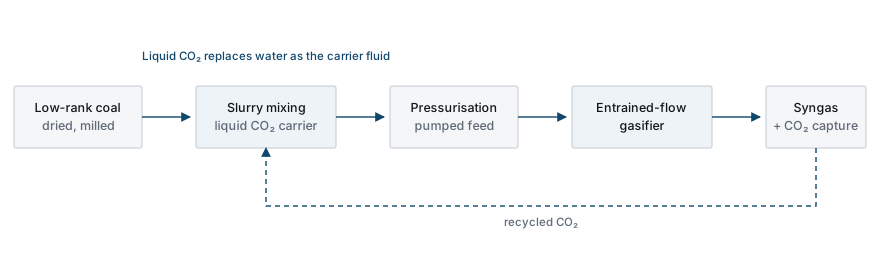
That last problem is more constraining than it appears. Entrained-flow gasifiers are normally fed a coal–water slurry, but water carries a large heat-of-vaporization penalty, and low-rank coals with high inherent moisture make it worse: the slurry either carries too little coal to be economic or is too viscous to pump. The research described below approaches this from two directions — understanding the rheology and atomization of the slurry itself, and replacing the carrier fluid.
Selected research history
Completed work, with dates. Nothing in this section is presented as ongoing.
Liquid carbon dioxide as a slurry carrier, 2011–2013
The Institute was a named team member on the project Liquid CO2 Slurry for Feeding Low Rank Coal (LRC) Gasifiers, one of six integrated gasification combined cycle projects announced by the U.S. Department of Energy on 9 September 2011. The Electric Power Research Institute held the award; the team also included Worley Parsons Group, Columbia University and ATS Rheosystems/REOLOGICA. The National Energy Technology Laboratory’s program overview of 12 July 2012 describes the scope as plant-wide technical and economic simulation, preliminary design and costing of a slurry preparation and mixing system, and laboratory measurement of the rheological properties of liquid CO2/low-rank-coal slurry. The Adelphi University faculty record describes John P. Dooher’s contribution as rheology testing and technical input. The final technical report was deposited with the DOE Office of Scientific and Technical Information under contract FE0007977. Full project record, funding figures and sources.
Carbon dioxide for viscosity reduction and solid-fuel dispersion, 2019
Work on the same underlying idea was published in Fuel in 2019, examining improved gasification efficiency in integrated gasification combined cycle plants together with viscosity reduction of liquid fuels and dispersion of solid fuels using liquid and gaseous carbon dioxide, with co-authors at the City College of New York and Innoveering LLC. doi:10.1016/j.fuel.2019.115848
Modular gasifier concepts, 2018–2019
Advanced concepts in modular coal and biomass gasifiers, published in the ASME Journal of Energy Resources Technology, addressed gasifier designs at a scale suited to distributed rather than central generation. doi:10.1115/1.4040526 Related conference work on process intensification for coal and biomass gasification for distributed power and hydrogen production was presented at the Clearwater Clean Energy Conference in 2022, carrying the Institute as an author affiliation. doi:10.52202/066314-0033
Catalytically controlled gasification for hydrogen, 2007
An investigation into a catalytically controlled reaction gasifier for the conversion of coal to hydrogen was published in the International Journal of Hydrogen Energy with Marco J. Castaldi. doi:10.1016/j.ijhydene.2007.06.014 Two patent filings in the same period addressed gasification process streams and tunable catalytic gasifiers; see patents.
Co-gasification of coal and biomass, 2008
Work on co-gasification of coal and biomass in slurry-fed entrained-flow reactors was presented at the 33rd International Technical Conference on Coal Utilization and Fuel Systems with Marco J. Castaldi and Heidi Butterman, and appears in the conference proceedings at pages 459–470.
Slurry modeling for gasification and direct combustion
An undated paper hosted by Adelphi University, Physio-Chemical Modeling of Coal and Coal/Biomass Slurries for Gasification and Direct Combustion Applications, carries the byline “Adelphi University/Dooher Institute of Physics and Energy” and describes a model developed in conjunction with the Electric Power Research Institute. Because the document prints no date, venue or page numbers, it is catalogued without a year and identified as not independently indexed.
Continuing research interests
These are the questions the program follows. They are not descriptions of work in progress, and no result is claimed for any of them.
- Carrier fluids other than water for high-solids-loading gasifier feeds, and the energy balance that results.
- Rheological limits on solids loading in dense suspensions of irregular, porous particles, and what particle-packing models predict about them.
- Atomization behavior of slurry feedstocks at elevated pressure, and its effect on conversion in entrained-flow gasifiers.
- Co-processing of biomass with low-rank coal, and the handling and rheology penalties biomass introduces.
- Gasifier configurations at distributed scale, including hydrogen production.
- System-level modeling of conversion efficiency and emissions for the above.
Research leadership and current program
This research area is led by John P. Dooher, Ph.D., Founder, President and Director of the Institute. In 2026 the Institute reports the Advanced Energy Systems Research Program as active under his research leadership.
Historical collaborations in this area include work with academic, government and industrial partners documented in the public record. Recurring collaborators named in published work include Marco J. Castaldi and Dean P. Modroukas. See collaborations.